


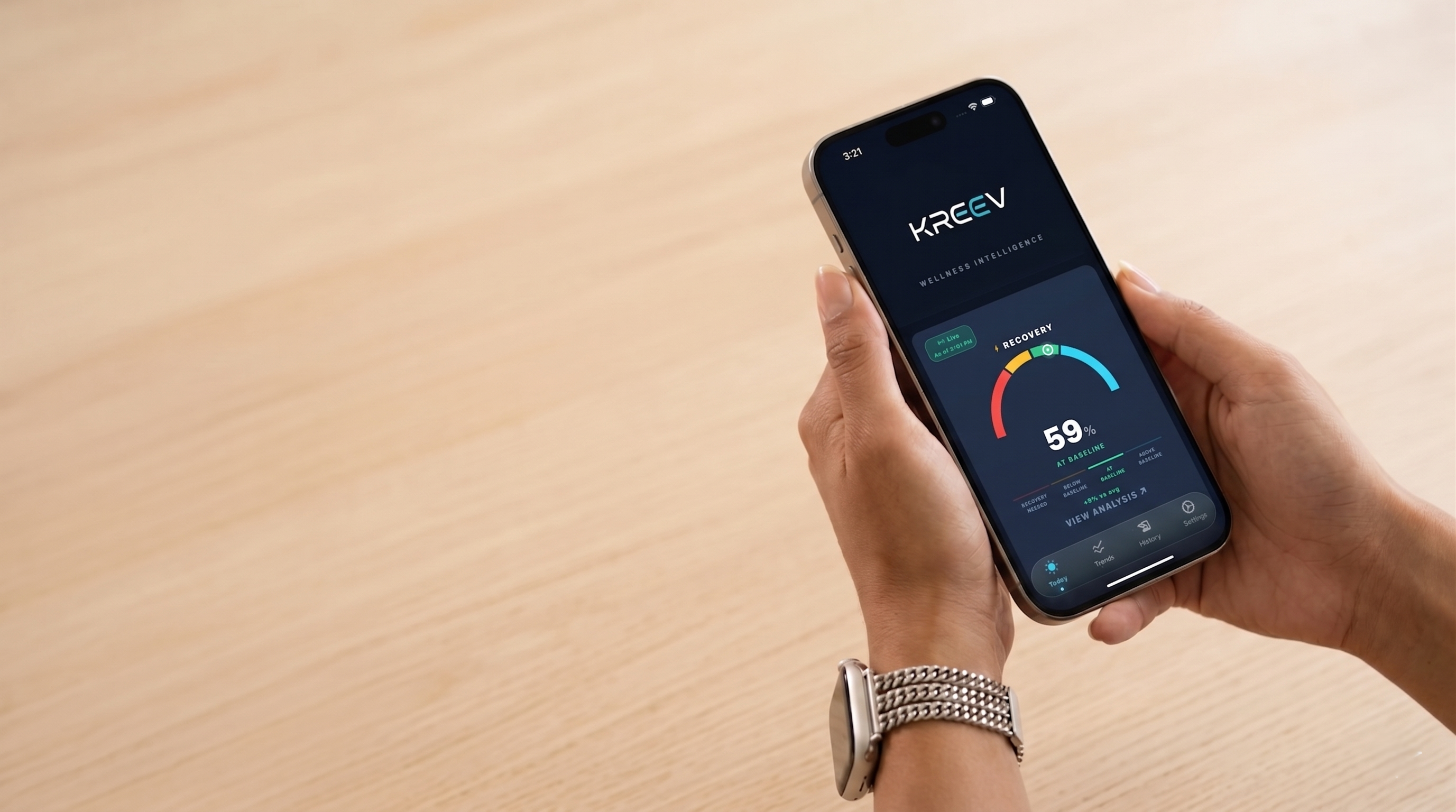

Your Apple Watch already tracks your health. Kreev turns that data into a personal Recovery Score — based on your body, not a population average — so you know exactly how you're doing each morning.
Our first beta has concluded — the next opens later in 2026
Or join the launch waitlist
Be first to know when we launch.
Coming soon.
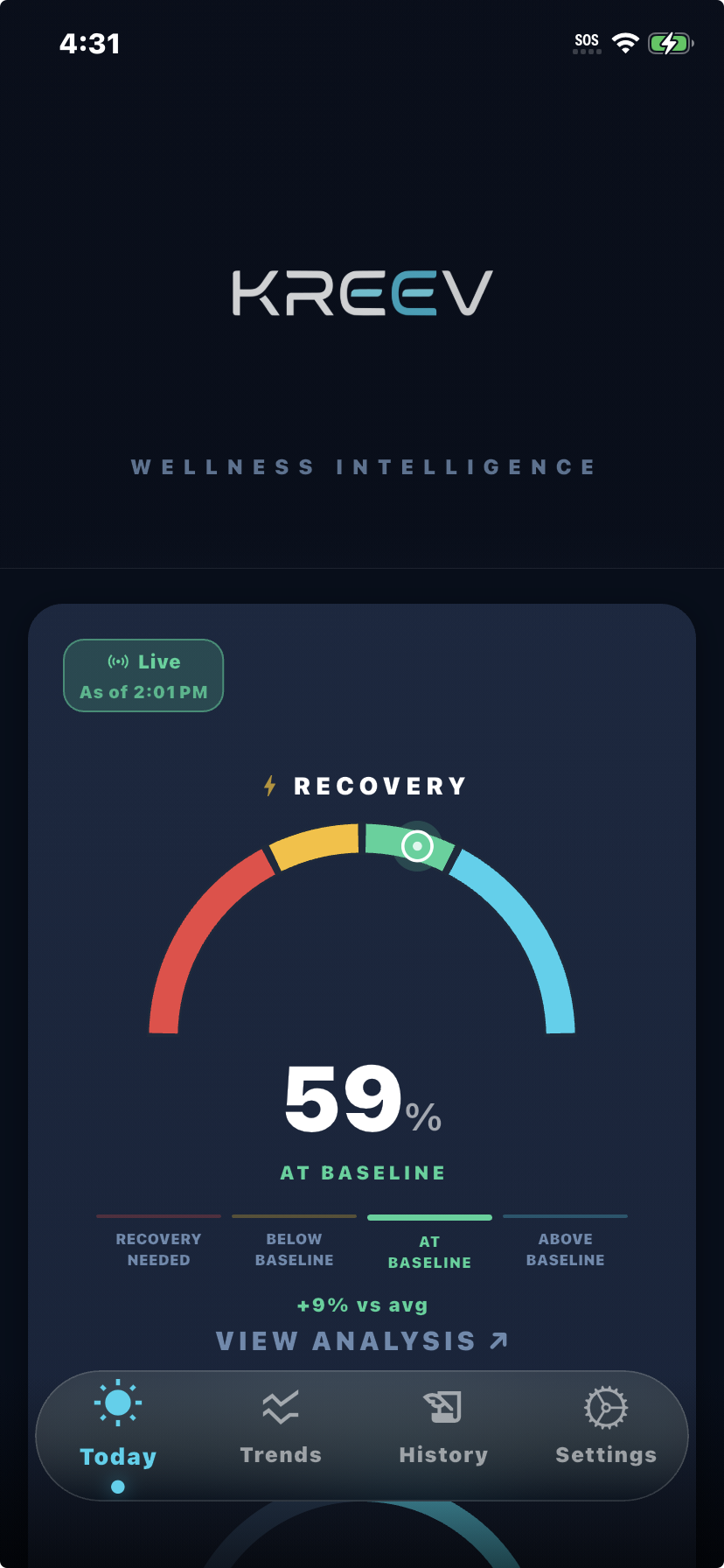
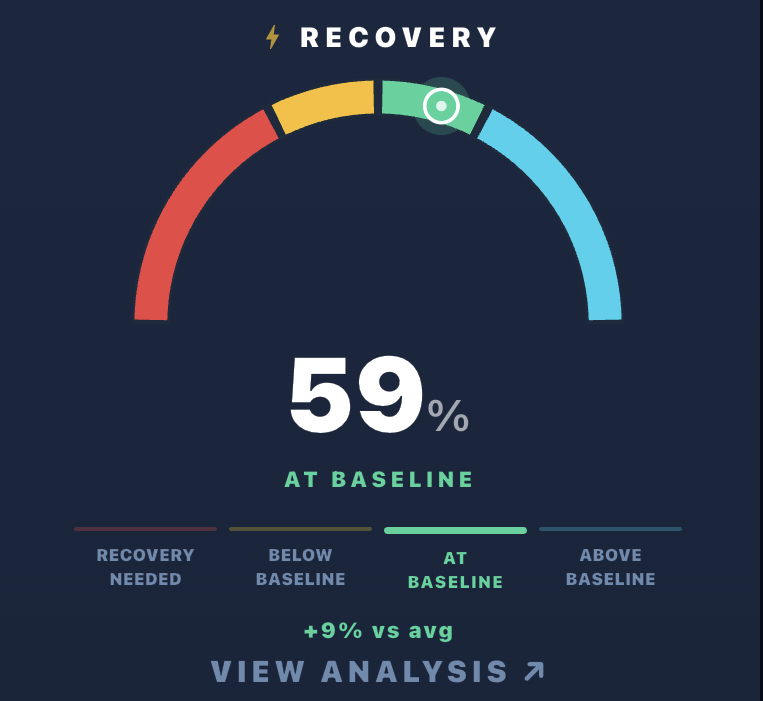
Every morning, Kreev analyses your overnight biometrics — heart rate variability, resting heart rate, sleep quality, activity load, respiratory rate — and distills them into a single Recovery Score from 0 to 100. Not a guess. Not a population average. A precise reading of how your body recovered, compared to your own history.
vs your personal baseline
Recovery Compass
Most wellness apps compare you to population averages — norms built from studies that may not reflect your age, fitness level, or physiology. Kreev is different. It builds a rolling baseline from your own recent history and measures how today deviates from your normal. An elite athlete with a resting heart rate of 42 bpm and a weekend jogger at 72 bpm both get scores that reflect their individual recovery — because the reference point is always you.
Your Apple Watch collects heart rate, HRV, sleep, steps, respiratory rate, and VO2 Max throughout the day and night.
Kreev builds a rolling average of your recent 7–60 days. This is your personal normal — unique to your body.
Each morning, today's metrics are compared to your baseline using Z-score statistics. The result is your Recovery Score.
Every metric has a story. Kreev reads them all.
See it in the app
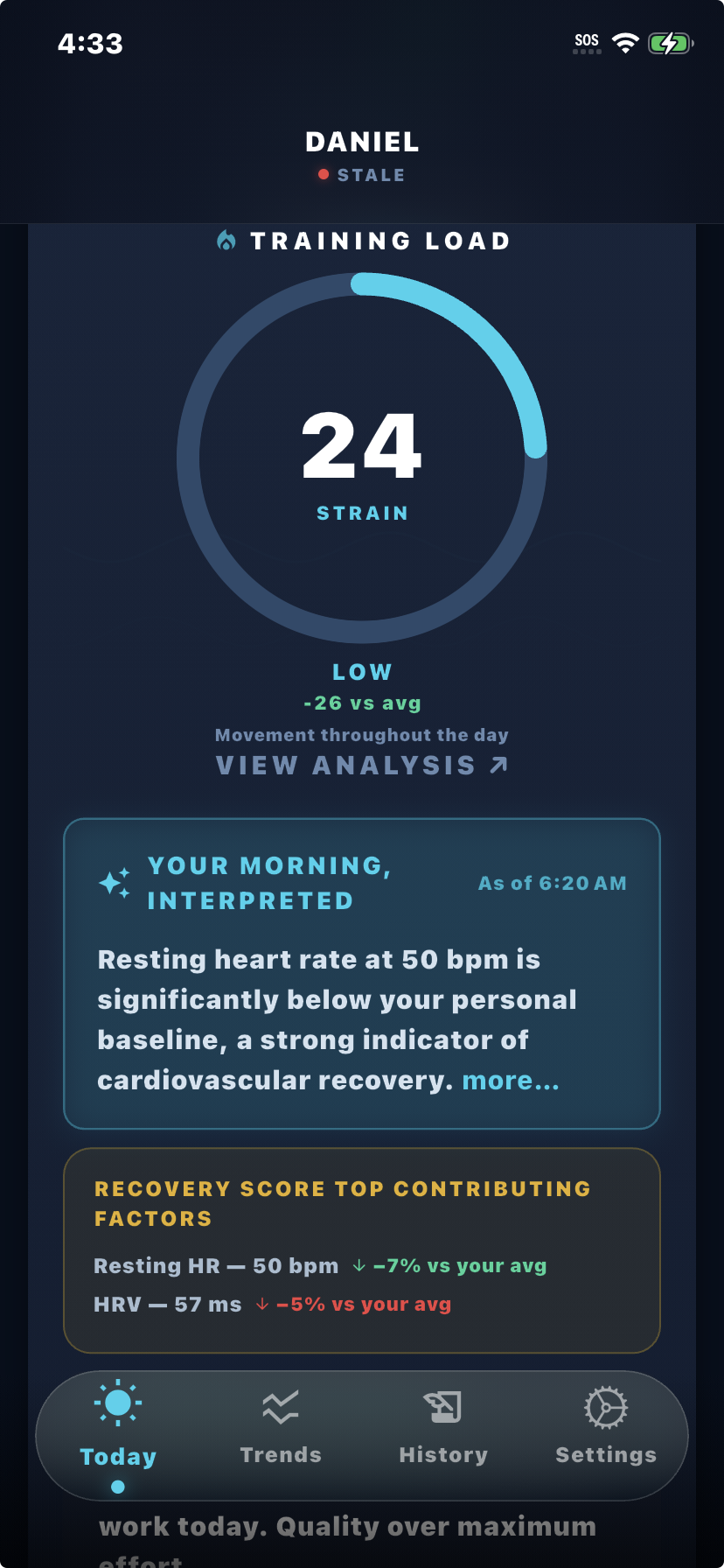
Your recovery score of 64 indicates you are tracking at your personal baseline today. HRV at 54 ms sits 7% below your 30-day average of 58 ms, pointing to mild residual autonomic load — likely from recent training sessions. Resting heart rate at 56 bpm is marginally elevated from your typical 54 bpm, consistent with moderate, unresolved physiological demand. Sleep duration of 7.1 hours and deep sleep at 18% of total time are in line with your recent norms. Yesterday's moderate activity load leaves no significant cumulative strain. You are recovered to your typical level — a standard training day is appropriate.
Every morning, Kreev generates a personalised narrative that explains exactly why your Recovery Score is what it is. Powered by Google Gemini, these narratives analyse your overnight metrics, compare them to your personal baseline, and describe the patterns in clear, analytical language. No medical jargon. No vague advice. Just your data, interpreted.
Anonymized data only — no names or identifiers are sent to AI
Google does not use your data to train or improve its models
You can request an explanation of any day's score
Your recovery score of 41 signals that your body is still processing yesterday's demands. HRV at 38ms is 28% below your 7-day baseline — a strong indicator of elevated sympathetic activity. Resting heart rate rose to 68 bpm, 16 beats above your recent average, consistent with unresolved cardiovascular stress. Sleep duration of 5.2 hours fell well short of your typical 7.1 hours; deep sleep accounted for just 9% of total time, limiting restorative physiological repair. High activity load from yesterday contributed significant cumulative strain. Consider a lighter training day and prioritise an earlier sleep onset tonight.
Kreev doesn't compare you to other users. A score of 41 means you are below your normal — not that you scored in the bottom half of all athletes. Context is everything.
Kreev is free to explore. Sentinel gives you the complete picture.
Your daily 0–100 readiness number, computed from 6 biometric signals compared to your personal baseline.
Full daily analysis powered by Google Gemini — explains your score in plain, analytical language every morning.
Daily cumulative physiological demand from exercise and activity, tracked against your personal baseline with trend visualization.
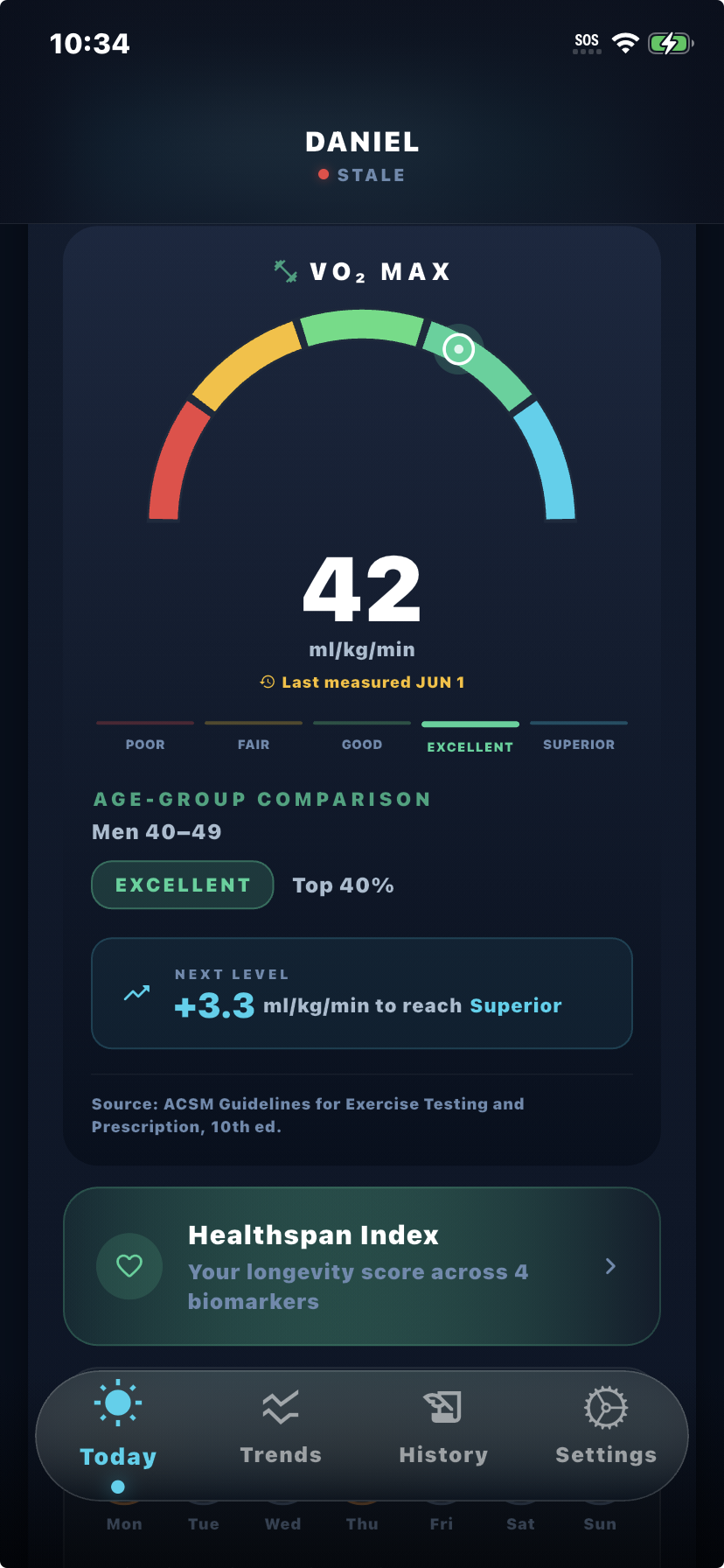
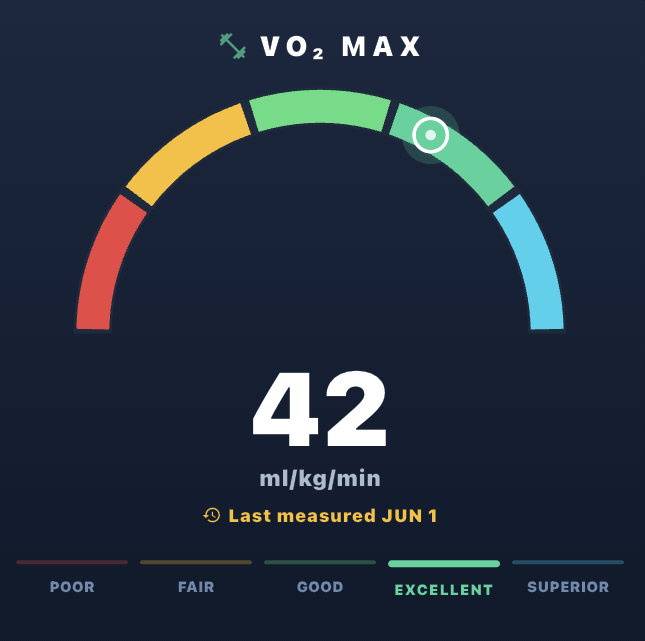
Your VO2 Max number, always free. Sentinel adds ACSM percentile ranking and your 90-day aerobic trend against your own history.
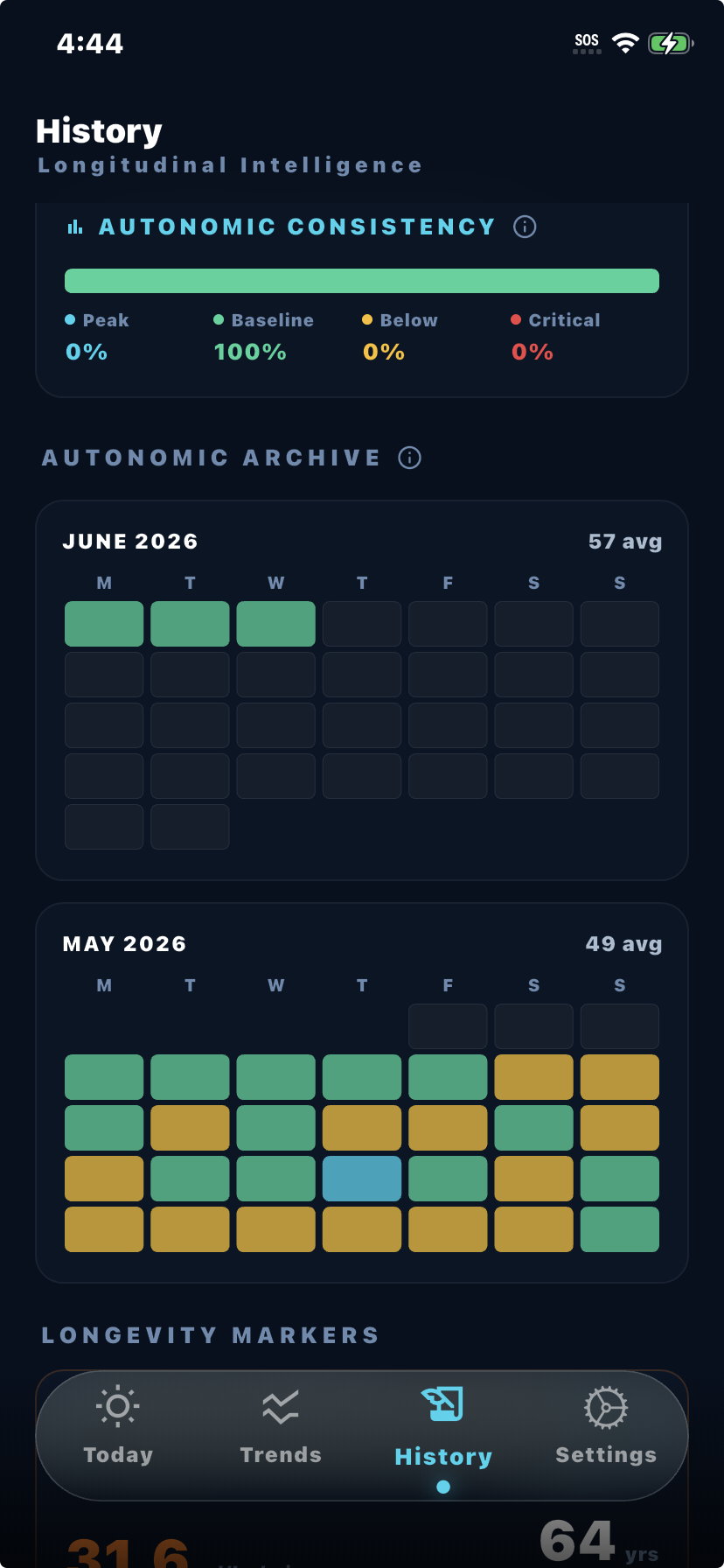
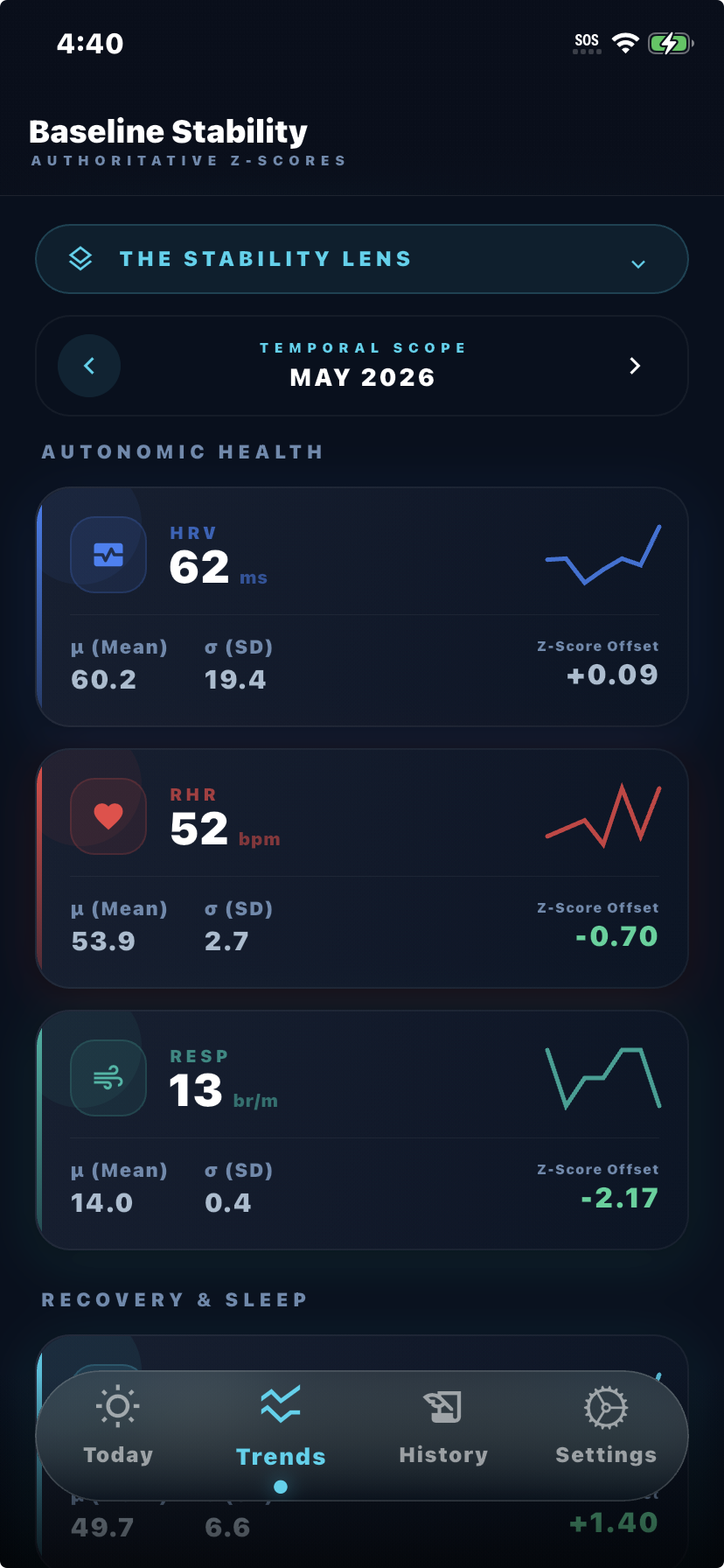
Baseline stability charts, 90-day heatmap, and pattern insights across all your biometric signals.
Push notifications when your recovery drops below your configured threshold — proactive pattern detection.
Z-scores, physiological position, analysis and compass tabs for every metric — every day, in full detail.
Side-by-side daily view of how your recovery and training load interact — exposing patterns in effort and adaptation over time.
A composite 0–100 score from five components: aerobic capacity, HRV, resting heart rate, sleep, and sleep regularity — you can add up the numbers the app shows and get your own score.
Daily intensity recommendations based on your Recovery Score — showing optimal windows for hard effort, moderate work, and rest throughout the week.
Tracks the regularity of your bedtime, wake time, and sleep duration across the week — because consistency matters as much as total hours.
A rolling view of fitness gain against accumulated fatigue — helping you identify when to push and when to back off for optimal long-term adaptation.
Free, forever: Recovery Score, Training Load/Strain, VO2 Max (the number), today's overnight metrics (current-week trends), and Trends tab charts (current month) — Sentinel extends both to up to 6 months. The History tab is Sentinel-only. No credit card, no time limit.
Most wellness apps treat their scoring algorithms as trade secrets. We believe you have the right to understand how your data is being interpreted. Kreev publishes its scoring methodology, names every company that touches your data, and gives you the tools to control, export, or delete everything.
Your Recovery Score uses Z-score statistics against your personal rolling baseline. We explain the methodology in our Terms of Service — no black boxes.
Your score doesn't factor in age, sex, or ethnicity. Every user is compared to their own history — not a population average.
We don't use advertising cookies. We don't sell your data. We don't share it with data brokers. Ever.
CCPA opt-out. MHMDA consumer health data rights. PIPEDA compliance. Algorithm explanation on request. Delete Account for full removal, Reset This Device to clear your data locally.
Read our Privacy Policy, Terms of Service, and Consumer Health Data Policy.
You train hard. You push limits. But the difference between progress and plateau isn't how hard you go — it's how well you recover. Kreev gives you the data to train smarter, sleep better, and understand the signals your body sends every day. Your baseline is your starting line. Your Recovery Score is the compass.
Join the WaitlistFree forever. Sentinel included free for your first 30 days — no credit card required.
Your Recovery Score, Strain, and VO2 Max are free — no hardware, no expiry. Sentinel adds the AI interpretation layer for $5.99/mo or $39.99/yr (~44% off), with a 30-day free trial included on every new account.
| Feature | Free | Sentinel |
|---|---|---|
| Recovery Score | ✓ | ✓ |
| Training Load / Strain | ✓ | ✓ |
| VO2 Max (number only) | ✓ | ✓ |
| Today's Metrics (HRV, RHR, Sleep, Respiratory Rate, Steps, Activity — Free: current-week trends. Sentinel: up to 6 months.) | ✓ | ✓ |
| Trends Charts (Free: current month. Sentinel: up to 6 months.) | ✓ | ✓ |
| AI Daily Narrative + Weekly Debrief + Month in Review | — | ✓ |
| Top Contributing Factors ("Why") | — | ✓ |
| Recovery vs Strain | — | ✓ |
| VO2 ACSM Ranking (category, percentile, next-tier target) | — | ✓ |
| Healthspan Index (5 components) | — | ✓ |
| Trends Long-Term Direction + prior months | — | ✓ |
| History Tab (Sentinel Pattern, Recurring Bottleneck, Your Patterns, monthly heatmaps, Autonomic Balance) | — | ✓ |
| Guardian Alerts | — | ✓ |
Every new account gets a 30-day Sentinel trial automatically — no credit card required. At day 30, your account reverts to Free (no data lost) unless you subscribe. Cancel anytime; we remind you before renewals.
Join the WaitlistFree forever. No hardware required. 30 days of Sentinel included, no credit card.
Requires iPhone with iOS 16+ and Apple Watch Series 4+